

个人简介
黑吃黑


推荐博文
势不可挡
2026-08-26
分类: 生活大爆炸第六季
势不可挡
Chinese team develops intelligent vision sensor that turns light signals into AI-ready tokens, reducing use of energy_我的网站

A | 香港麦当劳8月24日表示,早前因应台湾麦当劳暂停供应虾堡产品事件,即使所使用的虾饼批次及配方不同,香港麦当劳已即时预防性暂停出售有关产品,并主动委托多家国际认可的独立第三方检测机构,就有关虾饼样本进行多轮检测。综合结果显示,相关样本并未验出硝基呋喃及其代谢物,进一步确认符合食品安全要求。

B |
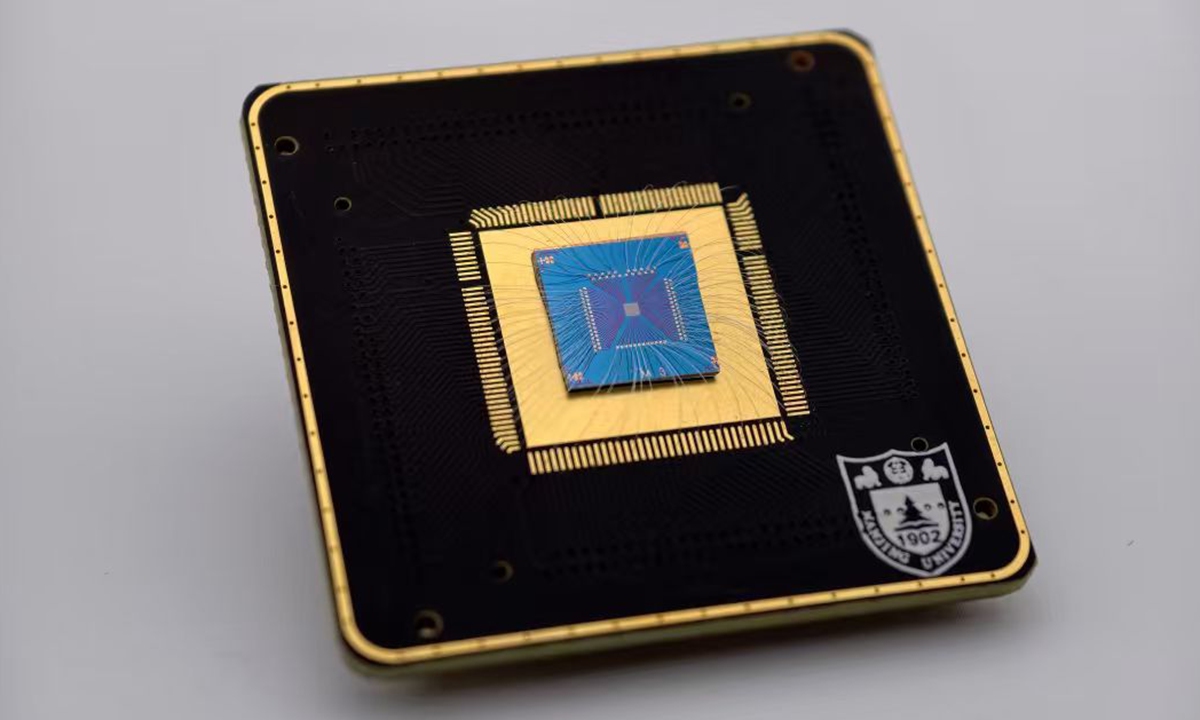
A Chinese research team from Nanjing University has developed a new ultra-low-power intelligent vision sensor chip, dubbed "LightTok," that can convert light signals into tokens within the sensor, significantly reducing the high energy consumption caused by frequent transfers of massive amounts of redundant data, the principal investigator told the Global Times.
According to a release from the Institute of Brain-Inspired Intelligence of Nanjing University, tokens generated by the LightTok chip can be directly fed into a Transformer encoder for image recognition.
"Our design idea was to move token generation onto the sensor itself, allowing the chip to directly produce tokens that AI models can process once light reaches the sensor," Miao Feng, director of the Institute of Brain-Inspired Intelligence at Nanjing University, told the Global Times on Thursday. "These tokens contain complete image information."
Physical AI refers to intelligent systems capable of autonomously perceiving, reasoning, acting and receiving feedback in the real world, representing a key pathway for AI to move from the digital realm into the physical world. Vision-based physical AI systems powered by large AI models need to convert visual information from real-world environments into tokens that can be processed by AI models before feeding these tokens into Transformers for subsequent tasks.
In traditional visual perception pipelines, light signals must go through multiple stages, including image sensing, analog-to-digital conversion, data buffering and transfer, digital image patching and embedding, before being transformed into tokens that AI models can process. The frequent transfer of massive amounts of redundant data has resulted in high energy consumption at the edge, according to a report by Science and Technology Daily.
The LightTok chip directly addresses a key challenge in physical AI hardware: how to efficiently acquire and tokenize visual information from the physical world with low energy consumption, Miao said.
The LightTok chip consists of a photosensitive memory array and peripheral circuits. The team built the array based on single-layer molybdenum disulfide (MoS₂) floating-gate phototransistors, with each pixel capable of sensing light, storing information and performing analog computing. By processing optical information directly within the chip, the device can convert captured visual signals into tokens for AI models, according to the research team.
The current LightTok prototype has a resolution of 32×32 pixels, or 1,024 photosensitive pixels, which is still smaller than that of smartphone cameras and industrial imaging systems. However, Miao said the technology is compatible with CMOS manufacturing processes and can be scaled up. With wafer-level growth of molybdenum disulfide materials, the chip could potentially achieve a scale comparable to existing imaging devices.
Miao said the chip also draws inspiration from the information-processing mechanism of human vision. Similar to how the retina extracts key visual information before transmitting it to the brain, the chip also aims to process visual information at an early stage.
The research was conducted in collaboration with another research team from the National University of Singapore. The findings were published on Wednesday in Nature Sensors, an internationally renowned journal in the field of sensing technology, according to the release.
Potential applications for LightTok include drone systems, autonomous remote sensing and small-scale embodied AI systems, Miao said. In these scenarios, devices need to continuously detect, understand and track targets, generating massive amounts of visual data. By reducing the energy required for visual processing, the technology could extend the operating time of drones, satellites and small robots with limited power supplies, the expert said.
。

C | 此前,台湾麦当劳8月13日发布声明称,“12日晚间收到进口厂商通知, ‘海味扬虾堡’及‘海味双层扬虾堡’所使用之进口虾排,虽然制造商出具合格海鲜食材检验文件,惟经后续自主抽样批次,检出硝基呋喃及其代谢物(人工合成抗生素)0.7 ppb(百亿分之七),不符合食品法规标准。”已立即采取预防性措施,全面停用虾排。

D |
Current article:http://www.xiongpeiduanlouduoennongleng.cyou/qr7644f/bpv.html
Published on:04:33:09
相关热门文章
- Vijay Varma Talks About Playing a Romantic Hero in Gustaakh Ishq
- 赛博科普|极速造星+火箭回收,中国民营航天这一发有多夯?
- 2026凯尔登·约翰逊中国行:以篮球之心,赴山河修行
- 阿根廷刚宣布“盈利”,国内就爆发全国罢工,到底谁“赚钱”了?
- 乒乓球德甲首轮:樊振东独得两分,杜塞尔多夫3-1击败对手


