
{主关键词}
夜行书生
Takaichi avoids clear commitment to non-nuclear principles again at Nagasaki memorial_我的网站

A |
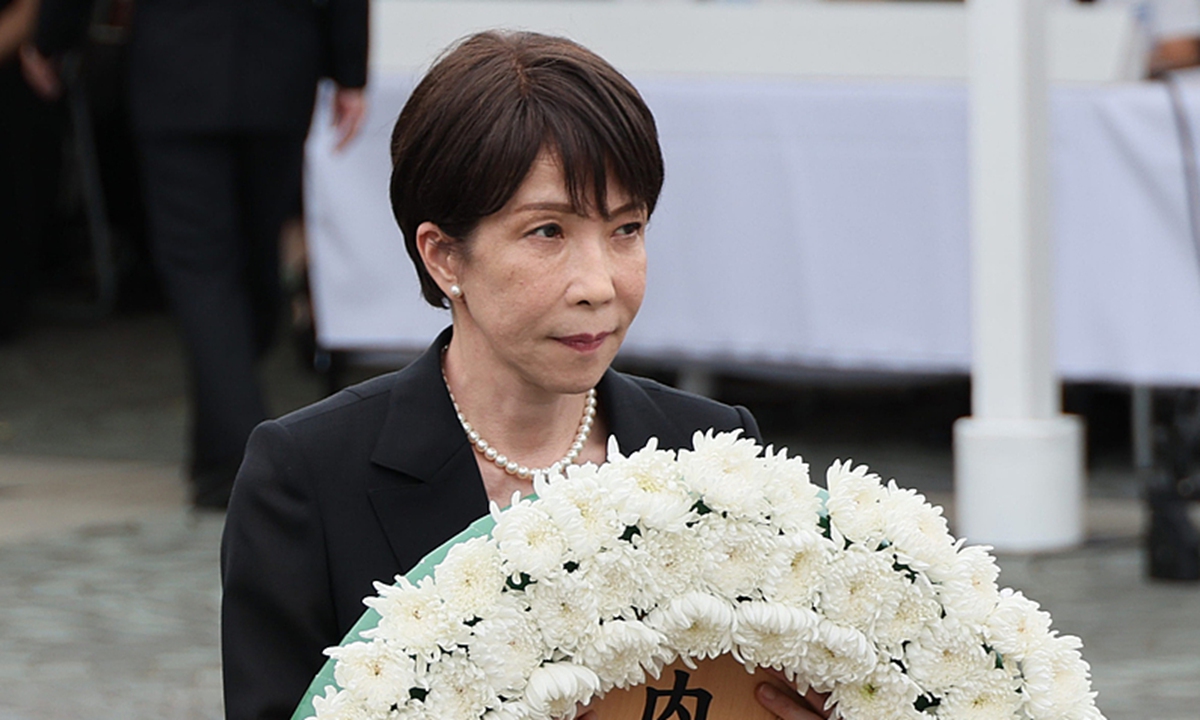
Chinese experts noted that, similar to her ambiguous remarks at the memorial ceremony in Hiroshima, Takaichi stopped short of making a clear commitment to maintaining the Three Non-Nuclear Principles in the future, as her government's stance on nuclear issues has sparked concern and anger among the Japanese public. They also warned that, given Japan's lack of thorough reflection on its wartime aggression, Tokyo's moves to dilute the Three Non-Nuclear Principles should raise alarm across the international community.
"Our country firmly upholds the three non-nuclear principles, and under the pledge that 'Nagasaki shall be the last city to suffer a nuclear attack,' we are promoting realistic and practical initiatives toward the realization of a world without nuclear weapons," Takaichi claimed, according to the Japan Times.
But unlike previous prime ministers, many of whom had pledged that Japan would "continue to uphold" the principles, Takaichi merely described the government's current position without making an explicit commitment about the future, per the report.
As Hiroshima observed the 81st anniversary of the US atomic bombing of the city on Thursday, Takaichi also emphasized that Japan pledges to achieve a world free of nuclear weapons while upholding the Three Non-Nuclear Principles, despite Japanese media noting that she has left the door open for future revisions.
Takaichi's remarks in Hiroshima and Nagasaki that Japan upholds the three non-nuclear principles were largely seen as a reaffirmation of the country's existing policy position rather than a pledge to maintain the principles in the future, Liu Jiangyong, a professor at the Institute of International Studies at Tsinghua University, told the Global Times.
Liu said that currently, some Japanese officials' dangerous remarks on nuclear have sparked criticism among Japanese society. He pointed out that Takaichi only referred to Japan's current adherence to the principles, without explicitly committing to preserving them going forward. Her subsequent focus on broader goals such as achieving a "world without nuclear weapons" has further fueled questions over her actual policy intentions.
Japanese Defense Minister Shinjiro Koizumi claimed in an online program released in July that discussions on nuclear weapons were necessary to strengthen Japan's defense capabilities, according to Kyodo News. While acknowledging that the issue was difficult to discuss in Japan, he claimed it was something that "could not be avoided."
Opposition to the Takaichi administration's nuclear-related moves has emerged across Japan, including from local governments, media organizations and civil society groups.
According to statistics from the Japanese Diet, at least 128 local assemblies across the country had submitted written opinions to the central government or parliament between Takaichi's inauguration on October 21 last year and July 28 this year, calling for the country's Three Non-Nuclear Principles to be upheld, according to Xinhua News Agency.
In an interview with the AFP, 82-year-old Satoshi Tanaka, a campaigner who survived the 1945 attack on Hiroshima expressed frustration that current political leaders like Takaichi are focusing on military capacity at the expense of diplomacy.
"There is so much talk about national security. What about building peace through diplomacy?" he said.
Responding to a question concerning the Japanese authorities are rebuilding Japan's war machine, seeking to revise the Three Non-Nuclear Principles, and pursuing nuclear sharing with the US, even the possession of nuclear weapons, Chinese Foreign Ministry spokesperson Lin Jian said on Thursday that the devastation and tragedies brought by nuclear weapons should never repeat themselves. That said, the particular context of the nuclear explosions should all the more be remembered and the lessons of Japanese militarism's aggression and expansion must forever serve as an alarm.
The Tokyo's moves on nuclear policy have also raised concerns in the international community.
Russia considers the rhetoric of Japanese authorities regarding the need for Japan to revise its Three Non-Nuclear Principles provocative and unacceptable, Russian Ambassador to Japan Nikolai Nozdrev said in an interview with RIA Novosti, which was published on Saturday.
Responding to Koizumi's remarks on nuclear discussion, Nozdrev said "This is the first time in Japan's history, as the only country to have suffered atomic bombings in Hiroshima and Nagasaki, that a sitting defense minister has publicly called for lifting the 'taboo' on discussions related to nuclear weapons. We consider such rhetoric from official Tokyo provocative and absolutely unacceptable."
Japan has yet to fully reckon with its wartime aggression, thus any attempt by Tokyo to move toward acquiring nuclear weapons could pose serious risks to regional peace and global security, Lü Chao, an expert on the Korean Peninsula issue at the Liaoning Academy of Social Sciences, told the Global Times.
Such concerns have become more pronounced as Japan increasingly portrays China as a major security challenge while highlighting perceived threats from other countries, against such a backdrop, any further steps to dilute the three non-nuclear principles are likely to heighten concerns internationally, particularly among countries that suffered from Japanese aggression during World War II, said Lü.
。
 漫威的老牌“冬兵”演员塞巴斯蒂安·斯坦澄清说,他对即将上映的 Avengers: Doomsday 一无所知,因为他在参与该片拍摄时从未读过完整的剧本。“我对此真的完全不知情,”斯坦在法国周报《星期日报》(Le Journal du Dimanche)最近发表的一篇法语采访中表示。
B | “因为我们没有剧本。我们只是拍摄了一些零散的场景。这是一种不断变化、持续进化的工作方式。制片方不希望我们阅读完整剧本,以免记者向我们提问。

C | 我已经遵守这个规则十五年了,已经习惯了。”斯坦的言论中还顺带提到了 The Batman: Part II 是另一个他无法谈论的项目。

D | 随后有报道称,《星期日报》的文章误引了斯坦关于他在该片中角色的描述,目前该文章已更新。值得注意的是,尽管斯坦参演了 Avengers: Doomsday,但他没有看过完整剧本的情况在漫威的核心群像大片中其实是常态。虽然具体细节略有不同,但此前有报道称,只有小罗伯特·唐尼和克里斯·埃文斯拿到了 Avengers: Infinity War 的完整剧本——尽管本尼迪克特·康伯巴奇当时也表示他也读过完整剧本。在关于 Avengers: Infinity War 和 Avengers: Endgame 的口述历史访谈中,罗素兄弟承认只有一位演员肯定看过了 Avengers: Endgame 的完整剧本:那就是小罗伯特·唐尼。用斯坦的话来说,能够参与如此规模的项目,同时仍保留日后作为观众观看的能力,是“这份工作的魅力所在”。看起来他将和许多人一起观看,据报道,Avengers: Doomsday 的预售票表现已经超过了 Spider-Man: Brand New Day。
Current article:http://www.xiongpeiduanlouduoennongleng.cyou/news/20260826_732.ppt
Published on:17:20:32
- 779新冠新毒株KP.2在美英等多国迅速传播,或更具传染性
- 4265738苹果地图广告正式在美国、加拿大上线,且无法关闭
- 18390英雄联盟职业联赛:TES夺得夏季赛常规赛冠军
- 7445经纪人化身“急救员” 贝壳、链家为社区应急救援增添力量
- 542原创 低至1.98元的港澳一日游,到底怎么赚钱?
- 4658斯科特:科比极具亲和力 曾不顾赛后采访和11岁的小孩促膝长谈
- 744299商家骗人并且虚假揽收
- 3527216赢创扩建本地工厂 满足亚洲肉类与绿色化学品需求
- 9264534国家防总、应急管理部针对京津冀蒙青启动防汛四级应急响应
- 391今天我市仍有明显阵雨或雷雨 山区、河谷等地质灾害风险等级高
- 228594快讯:工信部印发《促进中小企业特色产业集群发展暂行办法》,推动各类产业投资基金加大投资力度_的要求_肖芮冬
- 73275全省林业科普专题活动在漳州举行
- 363美欧宇航员再次出舱,继续完成通信天线安装工作
- 6884金洸华溪山禾玺:百万方水岸住区,以精工美学重塑龙华人居新标杆
- 9494一只猴子大闹印度小镇三天,6人遭重创,全民自卫抵抗猴王侵袭!
- 5432多特声明:“50+1规则”是德国足球核心支柱,契合会员主导的文化
- 2690794झारखंड विधानसभा की कार्यवाही अनिश्चितकाल के लिए स्थगित, स्पीकर बोले- जनता की आवाज को प्राथमिकता दें विधायक
- 3288月25日集合竞价:深中华A4连板 海鸥住工2连板
- 518726गुरुग्राम यूनिवर्सिटी के छात्र-छात्राओं के लिए खुशखबरी, Rapido के साथ साझेदारी से किराये में मिलेगा Discount
- 842罗文主持召开河北省消防安全视频调度会议
- 3004动力软件系统升级/优化能量管理 哈弗猛龙PHEV开启OTA升级
- 918提升竞技水平积累经验 四支足球国家队赴海外拉练
我的网站热门国内
- Copyright @ 2016-2017 我的网站 版权所有