
对话
China’s youth turn to immersive disaster simulations to learn survival skills_我的网站

A |
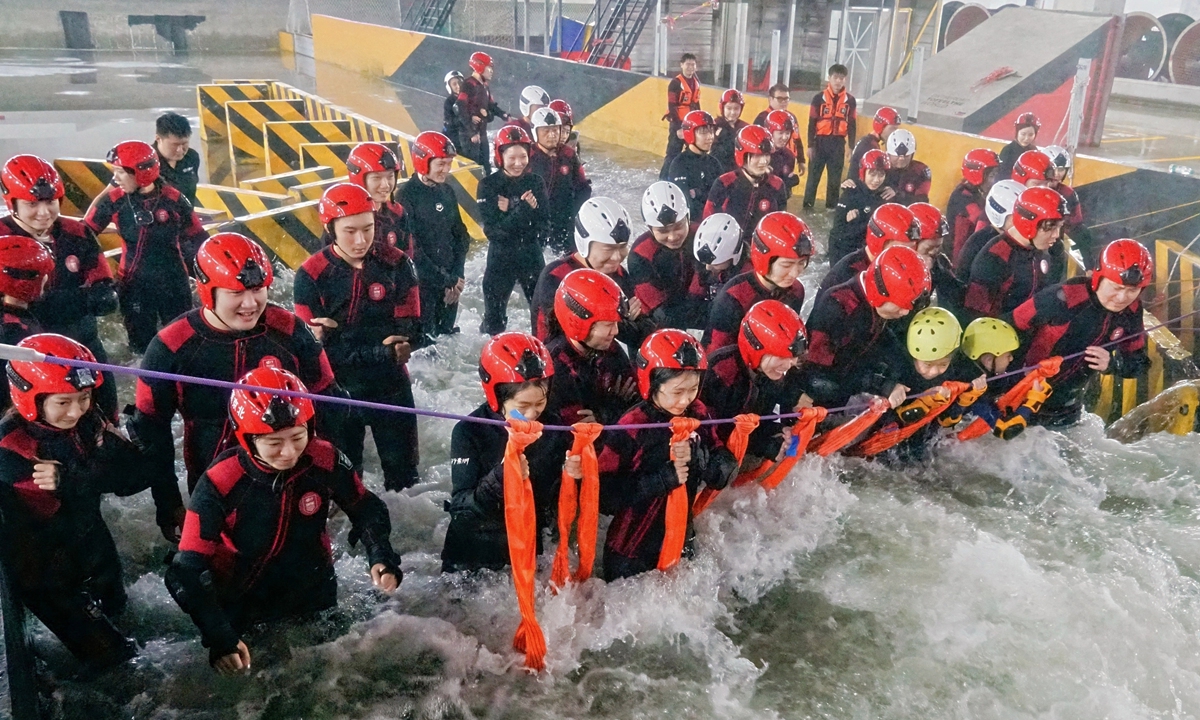
As heavy rain associated with Typhoon Dolphin continued to affect large parts of China, an increasing number of people were turning to immersive disaster simulations to experience extreme weather scenarios in a controlled environment at the Lvxing Disaster Simulation Training Center in Hangzhou, East China's Zhejiang Province.
At the country's first natural disaster simulation venue, adult participants pay 899 yuan ($133) per person to virtually confront situations such as typhoons, urban flooding and sudden flash floods, to gain a sense of what such emergencies might feel like.
Wang Kuanghan, operator of the training center, told the Global Times that the center is designed to allow people to experience the dangers of natural disasters in a safe and controlled environment, while raising awareness of the need to respect nature and avoid potential risks.
"We hope to pass on the experience we gained from encountering natural disasters during our years of traveling around the world," Wang said. "Beyond teaching people how to respond when natural disasters strike, what is more important is cultivating an awareness of how to avoid risks."
As of July, the center had received more than 70,000 visits this year for hands-on experiences, including tourists as well as companies and professional rescue teams that come for training. The number is higher than the same period in 2025, he noted.
Fu Minya, a Hangzhou-based office worker, told the Global Times that she has heard of the center and would like to give it a try.
"The frequent news reports of natural disasters in recent weeks have reminded people of how small and vulnerable we are in the face of nature's forces," she said.
After Typhoon Dolphin made landfall in China in early August, its remnant impact brought downpours to several provinces. Chinese authorities previously earmarked 80 million yuan to support flood and geological disaster relief efforts in the Central China's Henan and Hubei provinces and East China's Anhui Province, the Xinhua News Agency reported.
The flash flood simulation is one of the most intense experiences the center offers. Participants stand in a simulated river channel as an instructor presses a button, releasing around 500 tons of water from above. Within just three seconds, many participants are knocked off their feet, left tumbling in the rushing water and being swept toward the protective wall at the end of the channel.
"Real flash floods move even faster," said Wang. "When the water rises above knee level, it is almost impossible for an adult to remain standing. Many people instinctively think they should swim to escape, but that can be fatal."
Flash floods carry mud, branches and rocks that can quickly entangle your arms and legs. The right thing to do is to watch for warning signs of an impending flash flood, move away from the riverbank before the flash flood occurs, and quickly evacuate to higher ground on either side, he said.
In another exercise, several participants slog ahead holding each other's arms as the facility simulates winds reaching speeds of up to 165 kilometers per hour, as well as torrential rain.
However, there are concerns that simulated disasters could trivialize the suffering of disaster victims and turn the trauma of real-life disasters into entertainment.
This is a promising new niche in urban cultural tourism, Yu Jinlong, a Beijing-based cultural scholar, told the Global Times on Wednesday.
By striking the right balance between entertainment and public education while strictly adhering to safety protocols, such facilities can become more than just viral check-in destinations; they can serve as a replicable platform for public emergency education, Yu noted.
In the past, disaster-prevention education largely relied on display boards and lectures, which often made it difficult for people to develop an intuitive understanding of the dangers involved, Yu said.
Real-life simulations, by contrast, allow participants to experience firsthand the destructive force of typhoons and flash floods, turning abstract knowledge into tangible memories. This is where such facilities can offer unique social value, making them particularly suitable for educational programs for young people and emergency-response training for businesses and institutions, he said.
The experience can be impactful, but it should not be reduced to a sensationalist spectacle. Only by combining immersive experiences with practical self-rescue training and maintaining strict safety standards can this emerging model continue to serve as a meaningful platform for public disaster-prevention education, Yu noted.
Statistics show that 95 percent of people rescued from natural disasters survive through self-rescue, Wang said. "If you are swept away by water or hit by strong winds here, you will develop a much deeper understanding of how to respond to hazards and protect yourself."
。 灯火映星河 所梦皆璀璨 ——星湖幼儿园2025年新年贺词 岁月如织 光阴轻抚 我们依依惜别2024的尾声 心怀热忱 步履不停 我们满怀期待踏入2025的征程 ······ 幸福暖暖 2025 NEW YEAR 感恩并肩 可爱的孩子们, 感恩有你,活力相伴。

B | 回望过去一年, 你们用稚嫩的双手绘制成长的画卷。

C | 在幼儿园的每个瞬间, 都闪耀着进步的火花, 认知世界,自我表达,勇敢尝试! 未来的日子, 我们继续携手, 解锁更多成长的惊喜······ 敬爱的家长们, 感恩有您,一路同行。 您的理解与支持, 是幼儿园最坚实的后盾, 孩子成长的每一步都镌刻着您的陪伴, 我们心手相牵,共筑温馨, 见证每一份爱的滋养与绽放······ 亲爱的教职员工们, 感恩有你,携手共进。

D | 于浩瀚的教育星空下, 你们不单是熠熠星光, 更是孩子们心灵的灯塔。

E | 过去的一年, 你们于日常点滴中播撒希望, 在每一次互动中收获喜悦, 在教育的的漫漫征途中持续超越······ 新年的钟声敲响, 新的一年, 愿幸福常伴你们左右。 冬日暖阳,孕育希望, 新年新景,逐梦飞翔, 星湖幼儿园诚挚祝愿: 所有教职员工、家长和孩子们, 身体健康,平安喜乐, 家庭美满,新年大吉! 一审一校:陈越 俞星怡 二审二校:郑 纯 三审三校:田雅芸。

F |
Current article:http://www.xiongpeiduanlouduoennongleng.cyou/list_q50f/nwgs7yl.xlsx
Published on:08:59:33
评论
-
关于我们 | 我的网站 版权所有
Copyright ? 2019 我的网站 All Rights Reserved