死神来了
洛杉矶进入紧急状态,超3万人被迫撤离,为何大火在加州成了“家常便饭”?_我的网站

一 |
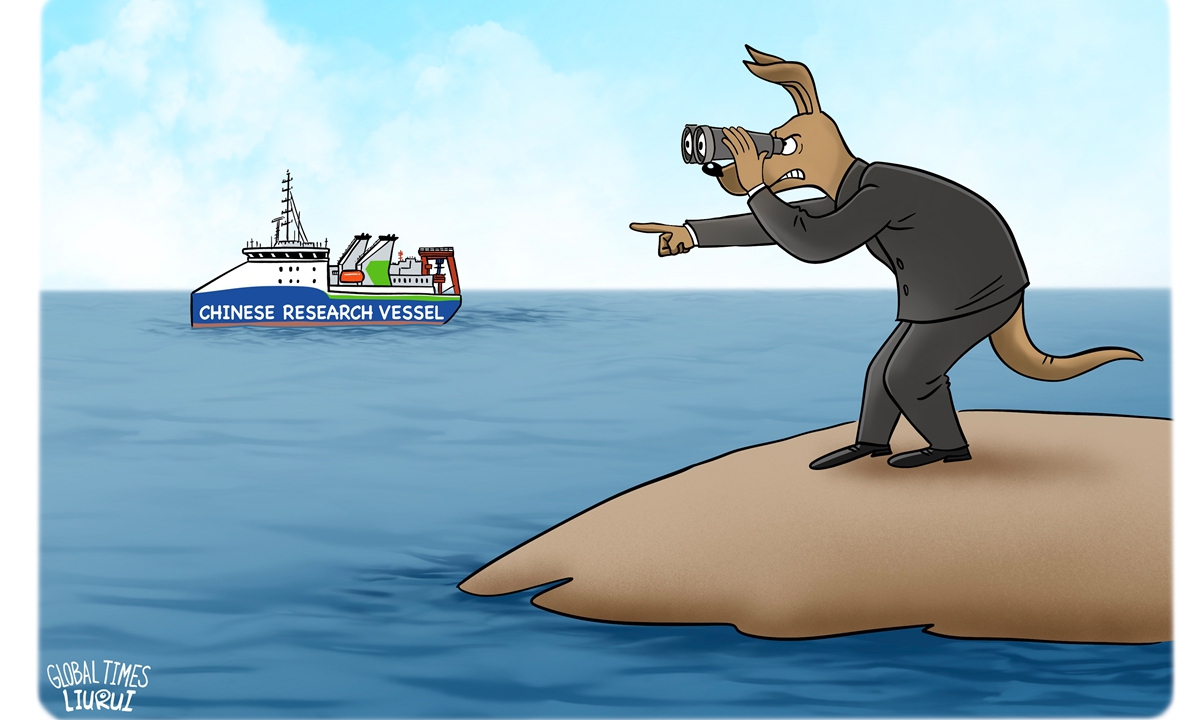
Illustration: Liu Rui/GTA new report funded by Australia's Department of Defense played up security risks to submarine cables in the Indo-Pacific waters and pointed finger at China and some other countries over alleged undersea‑cable attacks in recent years, while claiming threats against subsea cables are growing. A Chinese expert said that accusing China without conclusive evidence constitutes "over‑securitization" made by Australian side, as well as a calculated pretext for its own military expansion.
Published by the National Security College at the Australian National University (ANU), the paper claimed recent damage to cables in the Baltic Sea and around China's Taiwan region suggests "state actors are now actively probing and testing cable infrastructure in peacetime as part of broader hybrid warfare strategies" to rapidly degrade connectivity at the outset of a conflict, The Australian reported.
The paper claimed 16 privately owned subsea cables that carry 99 percent of Australia's internet traffic are a "high priority target" for Australia's adversaries that could be severed in a conflict, threatening the nation's economy and social fabric, according to The Australian.
The report singled out China and Russia for blame, saying that there have been multiple apparent attacks on submarine cables in recent years in European waters as well as near China's Taiwan region, suspected to be linked to Russia and China, the Straits Times reported.
However, the report cites a 2025 voyage by Chinese research vessel
Tan Suo Yi Hao along Australia's western and southern coastlines as evidence to back its claim that "potential adversaries are actively gathering information about Australia's cable infrastructure."
This report, relying on the routine scientific operations of a Chinese research vessel in 2025 to level allegations of offensive actions against China, and employing ambiguous terminology such as "suspected" and "potential," demonstrates Australia's evidentiary leap, Chen Hong, director of the Australian Studies Center of East China Normal University, told the Global Times on Monday.
This erroneous claim was refuted by the Chinese Foreign Ministry at the time. Chinese Foreign Ministry spokesperson Guo Jiakun said on March 31, 2025 that China carries out normal activities at sea in accordance with international law, including UNCLOS.
"We hope Australia will have a right understanding of this and stop the groundless suspicion and speculations," Guo added.
This is not the first time certain Australian politicians has leveled baseless accusations of China intending to sabotage its undersea cables. Back in May, Defense Minister Richard Marles claimed during the Shangri-La Dialogue that China ought to boost transparency around its maritime operations. He also asserted that a surge in damage to subsea cables had transformed the seabed into a "battlefield," per The Australian.
Chen said Australian side's scaremongering is tied to its predictive threat‑perception framework forged in recent years. This framework designates China and other countries as strategic competitors in advance, subsequently forces routine scientific activities into a confrontational framework, Chen said.
Apart from unfounded allegations against China, the paper claims Australia's defense military "must incorporate the defense of submarine cable infrastructure into its operational planning," according to The Australian.
It added the government should also consider up¬grading an auxiliary ship operated by the navy, ADV Guidance, to enable it to repair damaged cables.
The vast majority of submarine cable damages are caused by accidental factors such as fishing operations and vessel anchoring, rather than deliberate sabotage. For suspected cases of intentional damage, independent technical investigation bodies should be established, and the principle of "investigate first, characterize later" should be strictly applied, so as to prevent ordinary maritime accidents from escalating into diplomatic conflicts, Chen said.
The core problem of Australian side's submarine cable security lies entirely with itself. Instead of addressing its own infrastructure shortcomings and improving its domestic protection and maintenance systems, the Australian side has chosen to continually exaggerate external threats and stoke bloc confrontation, the expert added.
Chen said that by fabricating alleged Chinese threats, Australian side seeks to "rationalize" its military spending increases and underwater force expansion. The submarine digital infrastructure originally meant to serve global development has been labeled along us versus them lines, and this constitutes the biggest hidden danger, he added.
。

二 | 据新华社报道,美国加利福尼亚州南部地区7日突发野火,火势在强风助推下迅速蔓延,周边地区约3万人被紧急疏散,目前暂无人员伤亡报告。加州州长纽森当日傍晚宣布,加州南部部分区域进入紧急状态。图片来源:新华社据当地媒体报道,这场野火始于7日上午,起火地点在洛杉矶县沿海社区帕西菲克帕利塞兹。同时,一场强风暴在该地拉响警报,当地阵风风速据报曾超过每小时110公里。

三 | 此次风暴被认为是该地区十余年来最强风暴之一。过火面积因大风而急剧扩大。

四 | 据报道,目前山火已蔓延超过11.8平方公里,且还在继续扩大。洛杉矶市政府已安排部分居民撤离,多条道路被迫关闭。受强风影响,火势目前平均以每分钟烧毁5个足球场的速度继续蔓延。洛杉矶消防局局长克里斯汀·克劳利表示:“由于强风和周围地形的不利因素,控制火情极具挑战性,我们已经对洛杉矶地区超过3万名的居民下达了疏散令。”为安全起见,南加州电力公司切断了数万户居民的家庭用电。目前,数百名消防人员在现场灭火。但气象部门预报,入夜后当地风力将持续增强,恐加剧消防人员灭火难度。当地时间7日晚,美国总统拜登发表声明,称正不断听取有关洛杉矶山火的汇报,白宫将尽一切所能支持救援应对。森林大火在加州可谓家常便饭。就在上个月,2024年12月9日,加州洛杉矶县海滨城市马利布遭遇野火,大约2.2万人受火灾影响,6300人疏散;11月,美国东北部多个州近日爆发山火和林火;10月,一场大火因强风在加州奥克兰市山区迅速蔓延,烧毁两处房屋,大约500人接到疏散指令……据环球网2018年的数据,仅在2017年,加州就发生了8747场山火。

五 | 2018年10月,北加州就发生了250场山火,其中的21场扩大成为重大火灾,同年12月初,南加州发生了共20场山火,其中6场发展成重大火灾,迫使超过20万人紧急疏散。2024年,该州野火过火面积几乎是去年同期的4倍。据报道,加州年年大火,与其独特的地理位置和环境有关。加州在一年中的大部分时候都相对干燥,云量稀少、阳光充足,故而又被称为“阳光地带”。此外,加州自然景观极其丰富多样,从壮丽的峡谷、陡峭的高山、浩瀚的湖泊到干燥的沙漠、旖旎的海岸,几乎无所不包。全美59个国家公园中,有9个位于加州,加上近300个州立公园,森林覆盖率占到加州总面积的45%。在洛杉矶、旧金山等城市近郊山野,又生长着大量的桉树和浓密的灌木丛,易燃的松树+灌木丛,这都让加州几乎成为一个天然的“柴火灶”。加州的地形东高西低,海拔高差悬殊,极易形成温度高且又干燥的风,而这些大风是近年来山林大火频发的重要诱因。据报道,加州和其他美国西部地区野火多发,每年的这个时候会因大风而加剧。科学家认为,在气候变化导致的创纪录高温下,植被干燥使得火情更加严重。极目新闻综合新华社、环球时报、环球网(来源:极目新闻)更多精彩资讯请在应用市场下载“极目新闻”客户端,未经授权请勿转载,欢迎提供新闻线索,一经采纳即付报酬。24小时报料热线027-86777777。

六 |
Current article:http://www.xiongpeiduanlouduoennongleng.cyou/kt1/pizf.docx
Published on:13:44:01