
城市猎人
Major oil pipeline starts operation in East China, capable of pumping up to 70,000 tons of crude oil each day_我的网站

A |

China's high-tech exports surged over 50 percent year on year in July, well ahead of the 17.8-percent growth in total exports, customs data showed. The export gains are being mirrored in investment flows, with foreign funds moving into Chinese technology stocks and global indices adding newly listed hard-tech companies.
Rob Subbaraman, head of global macro research and co-head of global markets research at Nomura, said China's low-cost and abundant electricity supply, growing talent pool and early lead in physical AI are driving the rapid development of its AI industry chain.
China's development of open-weight models could accelerate their adoption by businesses, allowing productivity gains from AI as a general-purpose technology to spread more quickly across the economy, he said, citing models from Chinese firms including DeepSeek and Moonshot AI.
"The lower cost of these models was another advantage," he said, adding that the benefits could extend beyond China, particularly to emerging markets that could adopt cheaper Chinese AI models.
China's strength in advanced manufacturing has also become increasingly evident, said Robin Xing, chief China economist at Morgan Stanley, pointing to China's roughly half share of global installed new energy storage capacity and the rapid growth in outbound licensing deals for innovative drugs. These trends, he said, underpin the long-term investment case for China's hard-tech sector and leading manufacturers.
These strengths are increasingly being reflected in foreign investors' allocation decisions. This year, Goldman Sachs has twice raised its 12-month target for the CSI 300 on improving earnings momentum, and retained an overweight view on Chinese equities.
Kinger Lau, chief China equity strategist for Goldman Sachs Research, said the bank's positive view reflected improving earnings momentum, favorable macroeconomic and liquidity conditions. A-share equities offered international investors diversification benefits that remained underappreciated, along with attractive exposure to hard-tech and AI themes, he added.
Individual companies are drawing overseas interest too.
ChangXin Memory Technologies surged 465.82 percent on its debut on Shanghai's STAR Market last month, reaching a market capitalization of more than 3.2 trillion yuan (about 471.28 billion U.S. dollars).
U.S.-based Tema ETFs made the chipmaker a top holding at a 10.56 percent weight on its debut day, while MSCI officially added it to its China All Shares Index on Monday under a fast-track rule for large IPOs.
Robotics is where the enthusiasm is most visible. Unitree, set to become China's first mainland-listed humanoid robot maker, priced its Shanghai IPO at 150.8 yuan a share, representing 10 percent of its post-offering share capital. The offering is expected to raise about 6.1 billion yuan in gross proceeds.
That optimism, however, exists alongside broader economic pressures. Nathan Chow, senior economist at DBS Bank, said the imbalance between relatively strong supply and weak demand remained pronounced, with household consumption and some companies' profitability still under pressure.
Investment in infrastructure could help offset the weakness in private investment in the near term, while lowering logistics and energy costs and improving the efficiency of resource allocation over the longer term, Chow said. It could also strengthen supply chains and reduce the economy's exposure to external shocks and geopolitical risks, he added.
The implementation of policy measures would be key to sustaining the recovery in the second half of this year, analysts noted.
Economic management requires both easing the brakes and stepping on the accelerator, said Song Yu, chief China economist at UBS Securities, adding that faster fiscal spending and the use of bond proceeds, additional policy support and better coordination between fiscal and financial policies are needed, alongside measures to remove barriers to household consumption and improve the business environment.
"With stronger policy support and measures taking effect, China's economy is expected to maintain a steady recovery in the second half of the year," Chow said.
。
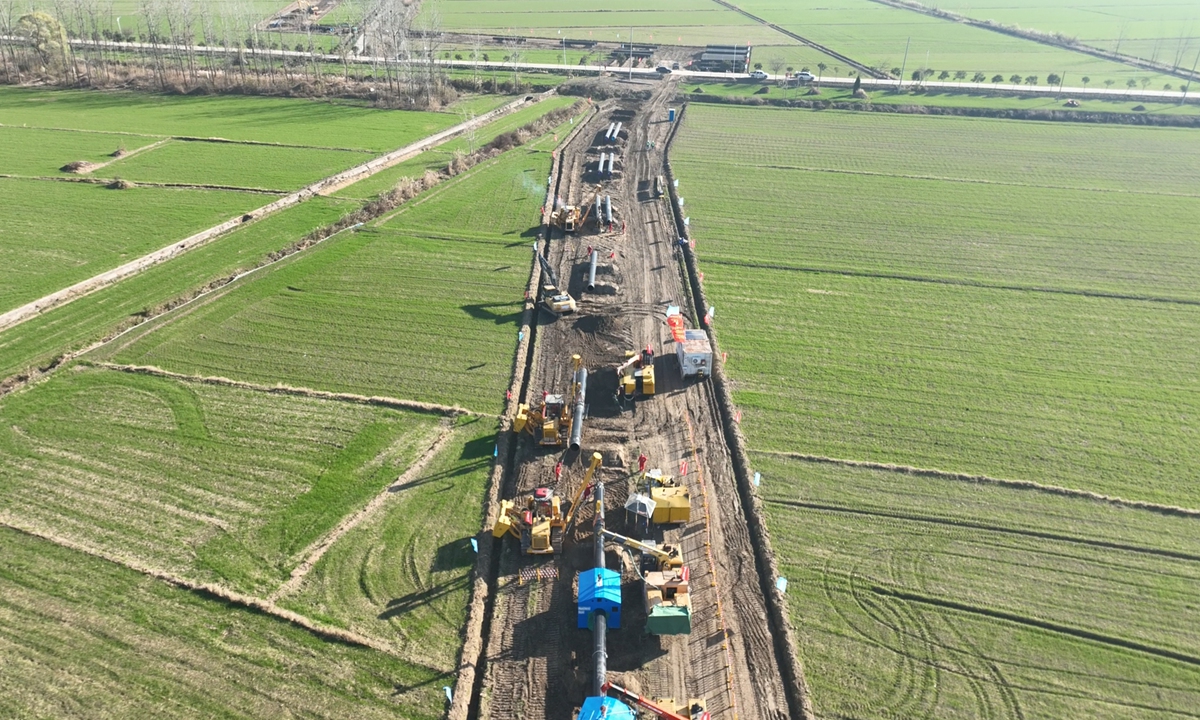
The Lianyungang-Yizheng crude oil pipeline, a key national oil and natural gas transport project, successfully commenced operations on its Lianyungang-Huai'an section on Thursday, PipeChina, the project developer, told the Global Times. The project can transport over 18 million tons of crude oil per year.
This marks the first 10-million-ton-level crude oil pipeline to be put into operation since the start of China's 15th Five-Year Plan (2026-30) period and is of significant importance for optimizing the country's energy supply structure in the central and eastern regions and improving the "nationwide one-network" layout of oil and gas infrastructure.
The Lianyungang-Huai'an section of the Lianyungang-Yizheng crude oil pipeline project has a total length of 143.8 kilometers and a designed annual transportation capacity of 18.5 million tons. Construction on the section began in October 2024 and was completed in June.
The pipeline has a diameter of 813 millimeters and a design pressure of 8.5 MPa. Up to 70,000 tons of crude can be pumped daily to Yizheng, a hub in East China, serving refineries in East China's Jiangsu Province and along the Yangtze River, strengthening energy supply security, the company said.
The commissioning of the new pipeline will further optimize the oil and natural gas pipeline network in the Yangtze River Delta region and the coordinated allocation over imported crude resource, PipeChina said.
Global Times
。

B |
Current article:http://www.xiongpeiduanlouduoennongleng.cyou/klc5/h6ep.docx
Published on:05:58:03
栏目相关
- G1火箭85-95勇士,赛后4坏消息!后场没法看,史密斯该增加球权!
- 京东方与3M共建联合实验室,推动柔性无痕折叠屏等创新技术迭代
- 【营养食谱】2025年上学期第四周食谱预告
- Taiwan island’s DPP rattled as Malaysian PM reaffirms Taiwan is part of China
- 哈马斯想要什么
- 多人在澳核酸检测呈阳性 中国男篮征调队员前往雅加达
- Beijing refrigerator claim exposes DPP-created 'information cocoon' in Taiwan: spokesperson
- 政声直达丨河北普通高校招生录取工作顺利结束
- 2只“高中签率”新股来了 别忘了打新
- 三维标记射线跟踪测试今天上线
- 《豪门盛宴》圆满收官 吉利银河借力顶级赛事IP持续释放品牌势能
- 联通营业厅和客服不给改29元绑宽带求办理
热门排行
- “台球皇帝”亨得利转战直播间 虎牙重塑斯诺克打开方式
- 大连机场单日旅客吞吐量首次突破8万人次,大连机场单日旅客吞吐量首次突破8万人次
- 新冠新毒株突袭,自美国下水道发现,已蔓延多国!世卫组织紧急出手!专家:更具传染性,或引发新一波疫情
- SK이노, SKIET 흡수합병으로 600억 비용 절감
- 古偶“退潮”谁撑起了暑期档?
- 任天堂《马力欧卡丁车世界》Switch 2 套装海外回归:549.99 美元,贵了 50 美元
- 三星 Galaxy S27 Ultra 手机机模曝光:厚约 7.9mm,重构后摄布局
- 14 Years of The Dirty Picture: What Makes The Vidya Balan Starrer Special Even Today
- Major solar panel plant opens in US amid backdrop of industry worries about imports
- 699元!Nothing Ear(3a)评测:便宜了,但Nothing味还在
- (乡村行·看振兴)太原小店区:一颗葡萄串起农文旅融合链,(乡村行·看振兴)太原小店区:一颗葡萄串起农文旅融合链
- 王鑫新产品厕所mt ios版下载链接已关闭