人工智能
China’s first supernode for 2t-parameter models enters service in Ulanqab_我的网站

A |
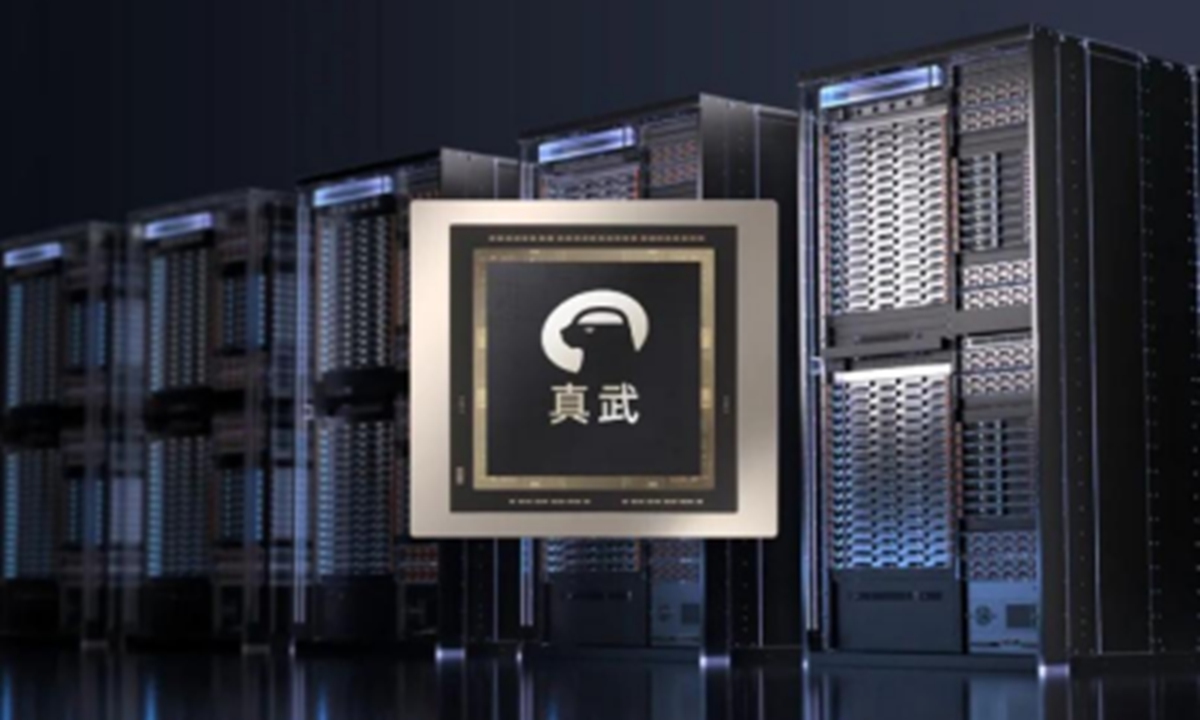
The instance is designed to handle inference for mixture-of-experts models with up to 10 trillion parameters, the company said in a statement sent to the Global Times on Wednesday.
This marks the first supernode-form computing architecture in China to successfully run large language models exceeding 2 trillion parameters, according to the company.
Industry expert Tian Feng told the Global Times that the commercial rollout of supernode infrastructure could significantly reduce training cycles, lower costs, and speed up iteration for AI developers requiring massive computational resources.
The company said the new instance has already been used to power commercial services for large language models such as KimiK3 and Qwen3.8Max.
The Lingjun Zhenwu M890 supernode instance supports FP8/FP4 low-precision computing. Through the ICNSwitch 1.0 chip, its scale-up interconnect scale has been expanded from 16 cards to 64 cards, with inter-card interconnect bandwidth boosted to 800 GB/s. Enterprises can provision 64-card, high-speed-interconnect computing units through the cloud without building their own data centers, according to the company.
In training scenarios such as autonomous driving and embodied intelligence, the instance delivers three times the training performance compared with the previous-generation Zhenwu 810E, the company said.
Ulanqab, where the supernode instance debuted, is one of Alibaba Cloud's five super data centers. The facility sources approximately 90 percent of its electricity from green energy, providing a low-carbon operating environment for high-density computing power.
Leveraging its climate, energy and network advantages, Ulanqab has transformed from "China's potato hometown" into the "token factory" - a term increasingly used in the AI industry to describe infrastructure dedicated to producing the digital building blocks generated by large language models.
By the end of 2025, the city had attracted 84 data center projects, including 81 intelligent computing centers, with total investment exceeding 500 billion yuan ($74.1 billion) and operational computing power reaching approximately 172,000 petaflops, ranking it firmly in the nation's top tier, according to domestic media reports.
On August 6, China's largest AI computing industrial park was completed and put into operation in Ulanqab. The project highlights a broader race in China to build massive AI data centers capable of supporting the next generation of AI models while addressing soaring electricity demand, according to Chinese experts.
In recent years, Inner Mongolia has been rapidly positioning itself as a global-scale AI computing center cluster. Major technology companies, including Huawei, Tencent, ByteDance and Alibaba; telecom operators China Mobile, China Telecom and China Unicom; as well as cyberspace infrastructure service provider VNET, have established computing facilities in the region.
As the AI industry gradually transitions from the training era to the inference era and large model parameters continue to expand, supernodes have become a central battleground for AI infrastructure.
Chinese vendors are accelerating deployments in this space. Huawei has commercially deployed more than 750 sets of its Ascend 384 supernodes across industries including internet, telecom operators, finance, education, healthcare, transportation and manufacturing. It is also the only domestic supernode to have trained state-of-the-art (SOTA) models.
Baidu AI Cloud has also launched its Tianchi 256-card supernode based on Kunlun chips, with support for major models including Wenxin, DeepSeek, GLM, and MiniMax.
Meanwhile, supercomputer manufacturer Sugon has unveiled China's first fully domestic 100,000-card AI supercluster Sugon 8000 (Dengfeng), integrating supercomputing and AI computing on a unified architecture. It has now been connected to the national supercomputing internet to provide computing services to government, research, and enterprise clients nationwide.
Tian, former dean of SenseTime's Intelligence Industry Research Institute, told the Global Times that the flurry of domestic supernode launches reflects a broader inflection point as China's AI sector pivots from training capacity toward efficient, large-scale inference.
The expert further said that the commercial viability of these systems - evidenced by Huawei's extensive deployed base, Baidu's rapid model adaptation and Sugon's integration into the national computing network - suggests domestic vendors are moving beyond proof-of-concept to genuine production-grade infrastructure, a prerequisite for sustaining the next wave of trillion-parameter model proliferation, Tian noted.
The move also underscores China's push for self-reliance in AI infrastructure as US chip export restrictions continue to tighten, Tian said, noting that, in the supernode domain, Chinese companies are shifting from imported graphics processing units toward homegrown interconnect chips and domestic compute clusters, a transition that could reshape value allocation across the AI industry chain.
。 CAMBODIA-KRATIE-MEKONG RIVER-FLOOD(260826) -- KRATIE, Aug. 26, 2026 (Xinhua) -- Monks take a boat through floodwater in Kratie province, Cambodia, Aug. 24, 2026. The flooding of the Mekong River has affected 13,688 families across four Cambodian provinces, forcing 1,551 families to evacuate to higher ground, a disaster control spokesperson said Tuesday. Soth Kim Kolmony, spokesperson for the National Committee for Disaster Management (NCDM), said Kratie, Tboung Khmum, Stung Treng, and Kampong Cham provinces have faced severe flooding since last Friday, triggered by the aftermath of Typhoon Saudel. (Photo by Sovannara/Xinhua)。
Current article:http://www.xiongpeiduanlouduoennongleng.cyou/iq98je/20260826/4308.html
Published on:07:52:00
最新文章
- 哈登3年9700万细节曝光!骑士夺冠赔率升第6:突围东部依然不易
- 在乡村建设上量体裁衣,让嘉州新村各美其美
- Microsoft Windows 10更新4月版本17134.556推送,带脱机软件包下载
- 《GTA6》葱哥粉丝线下嘲讽R星!拿着根韭葱在公司门口喊话
- 15中3仅得7分!杰伦-格林:这是我的季后赛首秀 我并不太担心
- 中国机群一落地,埃及空军瞬间懂了:西方给不了这么顶级的阵容!,兵器志,原创 中国机群一落地,埃及空军瞬间懂了:西方给不了这么顶级的阵容!
- 《郡县联播》:安全生产治本攻坚三年行动共排查重大隐患8.1万项
- 工信部:打造更多专精特新“小巨人”企业、制造业单项冠军企业
- 三巴旺巴刹临时厕所卫生问题引摊贩担忧
- 【海山幼儿园】万象复苏旭日升,抬头揽尽二月天。——中国传统节日“二月二,龙抬头”
标签云
热门文章
- 在“倒春寒”里卖掉11万辆,零跑做对了什么?
- 历经近2000次连续尝试,主播终于在《MVP Baseball 2005》中达成完全比赛
- 《Roco Kingdom》进军全球市场
- 【收评】不锈钢日内上涨0.53%机构称镍铁供应消息扰动,不锈钢期价或区间震荡
- 【政法宣传】弘扬宪法精神 坚定法治信仰——写在第十个国家宪法日到来之际
- Have We Forgotten the True Meaning of Labor Day?
- Over 60 countries, regions and international organizations to participate in 2026 CIFTIS
- Samantha Ruth Prabhu and Raj Nidimoru to Bankroll Films, Together
- “三资”家底清晰了 临平2.3万余件资产拥有了专属二维码
- 阳泉市推动主导产业迈向高端化、智能化、绿色化、融合化