诡域新娘
Black student suspended over his hairstyle to be sent to an alternative education program_我的网站

一 |
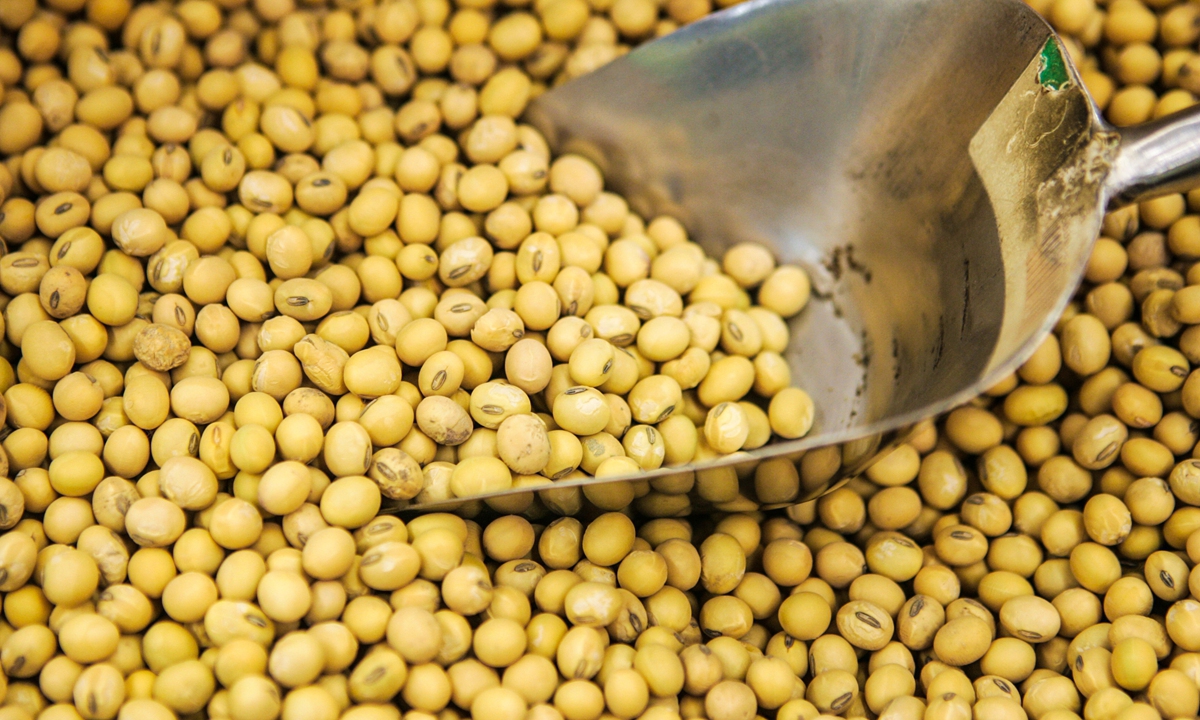
China continues to be the leading destination for Brazilian soybeans, and the Brazilian soybean industry wants to further deepen this relationship, expecting historically high volumes in the coming months, the Brazilian Association of Soybean Growers (Aprosoja Brasil) told the Global Times on Friday.
Brazilian soybean exports to China have remained very strong. China imported 12.08 million tons of soybeans from Brazil in June, up 13.7 percent year-on-year, while imports from the US fell 20.9 percent year-on-year to 1.27 million tons, according to data from the General Administration of Customs.
China imported 34.75 million tons of soybeans from Brazil during the period, up 9.1 percent year-on-year, according to Aprosoja Brasil. "Based on arrivals and customs clearance in China, there was clear growth," the association said.
According to the official data platform Brazilian Comex Stat, which records shipments at origin, 48.32 million metric tons were destined for China from January through June, largely unchanged from 48.41 million metric tons during the same period in 2025.
The difference between the two datasets mainly reflects timing and methodological differences between the recording of departures, cargoes in transit, arrivals and customs clearance.
Aprosoja Brasil said that the broader economic conclusion is the same: "Trade flows remained historically strong, China continued to be the leading destination for Brazilian soybeans, and Brazil's total soybean exports reached a first-half record of 69.57 million metric tons."
For farmers, strong export volumes help support the marketing of the crop, although record exports do not automatically mean record farm margins, said the Brazilian industry association.
China is the world's largest soybean importer. Imported soybeans are mainly used for oil production and animal feed. In terms of trading partners, China mainly imports soybean-related products from Brazil, the US, Argentina, Uruguay and Canada.
Brazil ranks among the world's leading soybean producers and exporters, with China being its largest export market for soybeans, according to the Xinhua News Agency.
Commenting on the significance of the Chinese market, Aprosoja Brasil said "China is absolutely strategic to Brazil's soybean industry," citing data showing that in 2025, China purchased 85.4 million metric tons, representing approximately 79 percent of all Brazilian soybean exports.
The two countries also have a highly complementary trade relationship. For Brazilian farmers, Chinese demand provides scale, market liquidity and greater capacity for long-term planning, said the Brazilian soybean industry association. For China, Brazil offers large, competitive and reliable supplies, as well as a crop calendar that complements production in other supplying countries.
Previously, policy shifts, such as US unilateral tariff measures, have caused disruption for US soybean farmers and other agricultural producers, Lü Xiang, research fellow at the Chinese Academy of Social Sciences, told the Global Times.
At the same time, China has been diversifying imports, including from Brazil and Argentina, to reduce risks from trade uncertainty, according to Lü.
Aprosoja Brasil noted that this partnership should not be seen merely as a temporary consequence of trade disputes involving third countries. Instead, it is a structural and mutually beneficial relationship, based on the complementarity between Brazil's production capacity and China's large demand for food, animal feed and protein, the industry group said.
Looking ahead to the soybean trade for the rest of the year, Aprosoja Brasil said that they are positive, while having a prudent mindset. Brazil has completed the harvest of a record soybean crop of approximately 180.6 million metric tons, and Brazilian soybean exports are expected to reach 116.3 million metric tons in 2026, which would also be a record, the association said.
"Brazil therefore has sufficient supply to continue serving the Chinese market strongly in the coming months... We expect historically high volumes, although not necessarily growth every single month, because soybean trade is seasonal and Northern Hemisphere supplies become more prominent during the second half of the year," it said.
。

二 | After serving more than a month of in-school suspension over his dreadlocks, a Black student in Texas was told he will be removed from his high school and sent to a disciplinary alternative education program on Thursday.Darryl George, 18, is a junior at Barbers Hill High School in Mont Belvieu and has been suspended since Aug. 31. He will be sent to EPIC, an alternative school program, from Oct. 12 through Nov. 29 for “failure to comply” with multiple campus and classroom regulations, the principal said in a Wednesday letter provided to The Associated Press by the family.Principal Lance Murphy wrote that George has repeatedly violated the district's “previously communicated standards of student conduct." The letter also says that George will be allowed to return to regular classroom instruction on Nov. 30 but will not be allowed to return to his high school's campus until then unless he's there to discuss his conduct with school administrators.Barbers Hill Independent School District prohibits male students from having hair extending below the eyebrows, ear lobes or top of a T-shirt collar, according to the student handbook. Additionally, hair on all students must be clean, well-groomed, geometrical and not an unnatural color or variation. The school does not require uniforms.George's mother, Darresha George, and the family's attorney deny the teenager's hairstyle violates the dress code. The family last month filed a formal complaint with the Texas Education Agency and a federal civil rights lawsuit against the state’s governor and attorney general, alleging they failed to enforce a new law outlawing discrimination based on hairstyles. The family alleges George's suspension and subsequent discipline violate the state’s CROWN Act, which took effect Sept. 1. The law, an acronym for “Create a Respectful and Open World for Natural Hair,” is intended to prohibit race-based hair discrimination and bars employers and schools from penalizing people because of hair texture or protective hairstyles including Afros, braids, dreadlocks, twists or Bantu knots. A federal version passed in the U.S. House last year, but was not successful in the Senate.The school district also filed a lawsuit in state district court asking a judge to clarify whether its dress code restrictions limiting student hair length for boys violates the CROWN Act. The lawsuit was filed in Chambers County, east of Houston.George’s school previously clashed with two other Black male students over the dress code. Barbers Hill officials told cousins De’Andre Arnold and Kaden Bradford they had to cut their dreadlocks in 2020. Their families sued the district in May 2020, and a federal judge later ruled the district’s hair policy was discriminatory. Their pending case helped spur Texas lawmakers to approve the state’s CROWN Act. Both students withdrew from the school, with Bradford returning after the judge’s ruling. ___AP journalist Juan Lozano contributed to this report from Houston.___The Associated Press education team receives support from the Carnegie Corporation of New York. The AP is solely responsible for all content.。
Current article:http://www.xiongpeiduanlouduoennongleng.cyou/cva1pd/32mk.xlsx
Published on:08:32:02